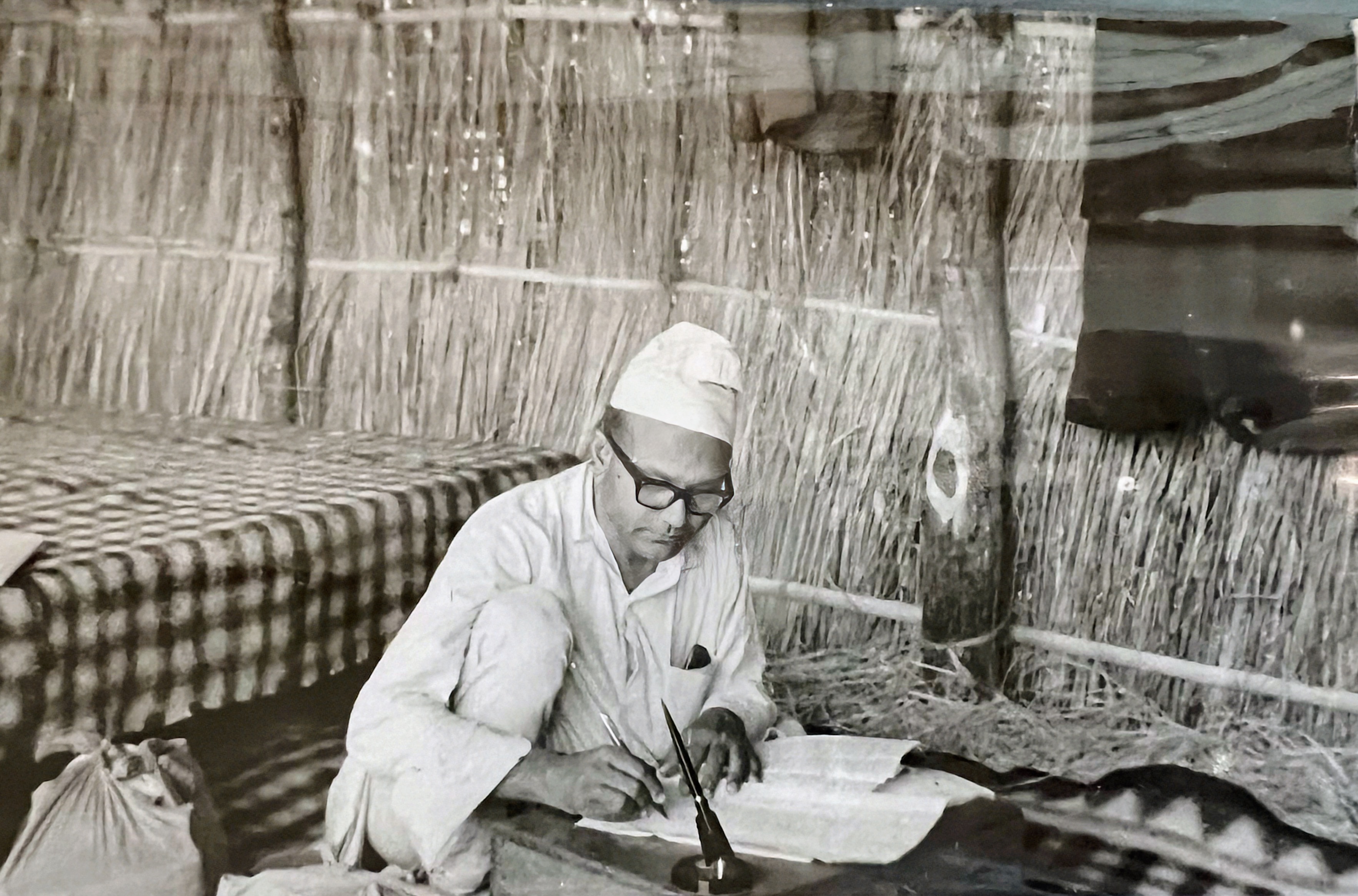
Devi Prasad Uprety
A Visionary Philanthropist & Social Reformer
Born: April 13, 1912 (Baisakh 1, 1969 B.S)
Passed Away: June 25, 1992 (Asar 11, 2049 B.S)
Devi Prasad Uprety, a native of Athrai, Tehrathum, is celebrated as a distinguished educationist and a remarkable philanthropist. His life illustrates the portrait of a true social reformer dedicated to bettering society through accessible, vocational, and scientific education.
Born into humble beginnings, Uprety's journey led him from dire circumstances to becoming a prosperous Zamindar in Jhapa. Guided by his father's wisdom and a passion for self-study, he chose to invest his wealth not in commerce, but in the future of his communities. His journey took him from a clerkship in Jhapa to Darjeeling, India, where interactions with luminaries like poet Laxmi Prasad Devkota ignited his literary and social pursuits.
A Lifetime of Service
1912 - 1929 AD (1969 B.S - 1986 B.S)
Early Life and Struggles
- Born into a poor family in Iwa, Simle village, Tehrathum, Nepal.
- Father Ravilal Uprety was an educator who conducted mobile schools.
- Faced financial difficulties after his father's death.
- Briefly worked as a clerk before leaving for the Madhesh region to seek better opportunities.
1929 - 1933 AD (1986 B.S - 1990 B.S)
Turning Point and Education
- Attempted the civil service exam after being inspired by a friend's education in Kathmandu.
- Developed a passion for literature through his association with poet Laxmi Prasad Devkota in Darjeeling.
- Became a regular reader and writer, contributing to Nepali journals.
1933 - 1992 AD (1990 B.S - 2049 B.S)
Political Awareness and Philanthropy
- Briefly involved in politics after the 1950 AD (2007 B.S) revolution.
- Served as a minister for law in the Eastern Collective Government for 10 months.
- Dedicated his life to educational activities, influenced by his mother's wish.
- Founded and funded more than 33 schools across Eastern Nepal, including the districts of Tehrathum, Ilam, Jhapa, and Taplejung.
- Donated nearly 900 bighas (~535 acres) of land to educational institutions.
- Established the village of Budhabare, Jhapa, by donating 1650 bighas (~1023 acres) for resettlement.
- Allocated 1500 bighas (~930 acres) to establish Anarmani, Jhapa, donating land to 150 families.
- Supported numerous temples and monasteries.
The Life and Legacy of Devi Prasad Uprety (1912–1994): From Humble Beginnings to Historic Generosity
Devi Prasad Uprety, a native of Athrai,Tehrathum in eastern Nepal, is celebrated as a distinguished educationist and a remarkable philanthropist. His life story illustrates the portrait of a true social reformer dedicated to bettering society. Uprety's visionary philosophy emphasized accessible, vocational, and scientific education, still relevant today.
Born(Baisakh 1, 1969 B.S/ April 13, 1912 AD) into a poor family in Iwa, Simle village, Tehrathum, Nepal, Uprety's journey led him from dire circumstances to prosperity as a Zamindar in Jhapa. Guided by his father's wisdom in law, accounting, and self-study, he started as a clerk and later became the wealthiest landowner in Jhapa,Nepal choosing to invest his wealth in education and societal welfare.
In 1984 B.S(1927 AD), Uprety gained a deep understanding of legal matters and accounting, embarking on a journey to Madhesh(Terai/Plains in Nepal) and in 1986 B.S(1929 AD) to the capital Kathmandu to pursue education. Despite financial hardships, he overcame obstacles and even succeeded in a civil service exam in Kathmandu. His journey took him to Jhapa,Nepal where he worked as a clerk but later relocated to Darjeeling, India.
In Darjeeling, interactions with renowned poet Laxmi Prasad Devkota and intellectuals like Purna Bahadur 'Manav' ignited his literary pursuits. Uprety's political and social thinking evolved through meetings with leaders like B.P. Koirala and Krishna Prasad Bhattarai in Darjeeling, and later he also served as a minister for law in the Eastern Collective Government after the 2007 B.S.(1950 AD) revolution in Nepal.
Uprety's philanthropy expanded when his mother, Laxmi Bai, expressed a desire to establish educational institutions in their village of Simle in Terhathum District. Honoring his mother's wish, Uprety founded the Pranami Primary School in Rijal Dara and the Pokhari Jr. High School. By 2016 B.S (1959 AD), Uprety had transformed into a respected educationist and generous land donor, directing significant resources, including 900 bighas(~535 acres) of land, to more than 33 educational institutions in 2017 B.S.(1960 AD) toward education in an era where others pursued wealth in commerce. Uprety also established a new village called Budhabare in Jhapa, Nepal, with 1650 bighas (~1023 acres) of land donated for the resettlement of 10,000 people displaced during the People's Revolution of 2007 B.S. (1950 A.D) in Nepal. Additionally, 1500 bighas (~930 acres) of land were allocated, with 10 bighas (~6.2 acres) donated to each of the 150 families in the newly established Anarmani in Jhapa district, eastern Nepal. Uprety's philanthropic journey was rooted in his modest background and early exposure to his father's mobile schools, where he developed remarkable academic aptitude, extending his generosity to temples and monasteries as well.
Uprety's legacy as a philanthropic social reformer, advocate for accessible education, and promoter of social progress was profound. He instilled new values in education, fought casteism, and catalyzed a philosophical and cultural transformation in Nepal. Recognizing his enduring contributions, a commemorative postal stamp is issued to honor his lasting impact by the Government of Nepal in 2015 AD. Devi Prasad Uprety life exemplifies the transformative power of determination and firm dedication to philanthropy, education, and societal betterment.